
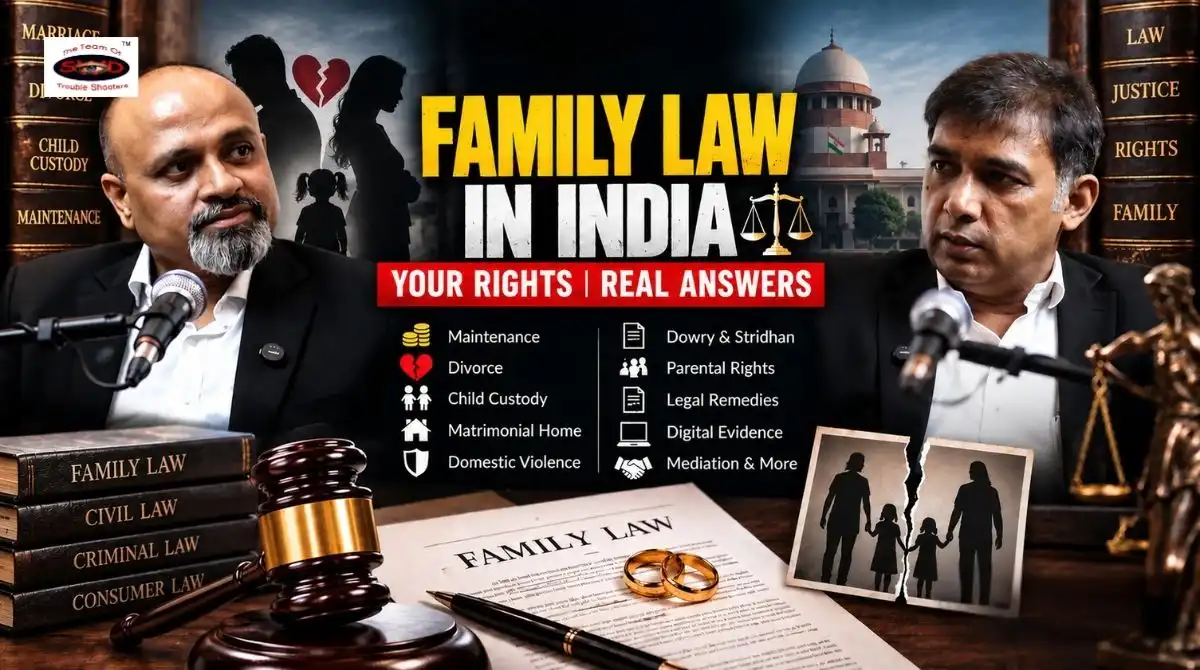
Family law in India covers several important issues that may arise during family disputes, including maintenance, divorce, child custody, domestic violence, matrimonial residence, Stridhan, dowry allegations and parental rights. When a relationship breaks down, these matters can quickly become both emotionally challenging and legally complex.
Unfortunately, many people do not understand their legal options until they are already facing a serious dispute. Some rely completely on social media videos, online discussions or advice from friends. While basic information can help people understand a situation, every family dispute has its own facts and circumstances.
Watch the Complete Family Law Discussion on YouTube
This article, Family Law in India, is based on an informative discussion featured on the Detective Guru YouTube channel, where Rahul Rai Gupta, popularly known as Detective Guru, discussed important family and matrimonial law questions with Mr. Anand Dabas, an experienced legal professional and advocate.
Mr. Rahul Rai Gupta: Experience From the Investigation Field
Rahul Rai Gupta, popularly known as Detective Guru, has spent decades working in the private investigation field. His experience includes personal and corporate investigations, where he has interacted with people facing different types of matrimonial, family and relationship disputes.
Through his work, he has seen that many people facing personal and matrimonial problems often have questions about their legal rights but may not know where to find reliable information. This is especially true when they are trying to understand family law in India, including issues related to marriage, divorce, maintenance, child custody and other family disputes.
This podcast discussion with Mr. Anand Dabas addresses several commonly asked questions and provides viewers with general legal awareness about family law in India.
Mr. Anand Dabas: Experienced Advocate and Legal Professional
Mr. Anand Dabas is a legal professional with a Bachelor of Law degree and over 15 years of experience in litigation, legal documentation and strategy. He has practised before the Delhi High Court, District Courts and NCR courts, and has worked with Pernod Ricard India Pvt. Ltd. and Khurana & Co. His practice areas include civil, criminal and consumer laws.
Does an Unemployed Husband Have to Pay Maintenance?
Courts do not decide maintenance solely based on whether a husband is employed. They may consider his earning capacity, assets, lifestyle and the applicant’s financial needs. During the proceedings, courts may also grant interim maintenance when the circumstances justify it. The final outcome depends on the facts of each case, so individuals should seek legal advice.
Can a Working Wife Receive Maintenance?
A woman does not automatically lose her right to maintenance because she is educated or employed. Courts may consider:
- Her actual income and financial independence
- Her ability to support herself
- The standard of living during the marriage
- The husband’s financial circumstances
- Income documents and other evidence
- The outcome depends on the facts of each case.
What Can a Husband or Wife Do If Their Spouse Leaves the Matrimonial Home?
When one spouse leaves the matrimonial home, the first question is usually: Why did the separation happen?
The answer may involve allegations from both sides. One person may claim that they were forced to leave, while the other may claim that the spouse left voluntarily.
Depending on the circumstances, possible options may include:
- Attempting reconciliation
- Family discussions
- Mediation
- Seeking appropriate legal remedies
- Filing relevant matrimonial proceedings
Child Custody Laws in India: Who Gets Custody?
A common question is whether child custody automatically goes to the mother. The answer is not always simple. The welfare and best interests of the child are central considerations in custody matters. Courts may examine factors such as:
- The child’s safety
- Physical and emotional well-being
- Education
- Living environment
- Financial support
- Stability
- The ability of each parent to care for the child
Child Visitation Rights After Separation
- Custody and visitation are not always the same thing.
- One parent may have physical custody, while the other may seek opportunities to meet and maintain a relationship with the child.
- Both parents should avoid involving children in their personal conflicts.
- A child should not be unnecessarily encouraged to see one parent as a villain because of disputes between the adults.
- Disagreements between spouses should be separated from their responsibilities as parents wherever possible.
- Healthy parenting arrangements should focus on the welfare and emotional development of the child.
What is the Difference Between Stridhan and Dowry?
Stridhan and dowry are often treated as the same thing, but they are different legal concepts.
- Stridhan may generally include property, gifts, jewellery and personal belongings received by a woman.
- The classification of Stridhan depends on the applicable legal provisions and the circumstances of the case.
- A dispute may arise when a woman leaves the matrimonial home and her personal belongings remain in someone else’s possession.
- Dowry-related matters concern demands for dowry made in connection with a marriage or allegations relating to such demands.
- Whether a gift or property is treated as Stridhan or dowry may depend on:
- Such matters may have both civil and criminal legal consequences.
- Therefore, it is important to seek qualified legal advice in any dispute involving Stridhan or dowry.
How Investigation Can Help in Matrimonial and Family Disputes
Family disputes often involve conflicting versions of events, particularly in matters related to family law in India. One person may make an allegation while the other denies it. In some situations, facts need to be verified before appropriate legal decisions can be made. This is where lawful and professional investigation may become relevant.
Detective Guru, led by Rahul Rai Gupta, provides personal and corporate investigation services.Services may include:
- Fact verification
- Background checks
- Lawful information gathering
- Matrimonial investigations
- Investigators can help clarify facts in family and relationship disputes.
- An investigator does not replace a lawyer.
- The best approach combines lawful investigation with proper legal guidance.
Do Grandparents Have Rights to Meet Their Grandchildren?
Grandparents often play an important role in a child’s life, but disputes between parents can sometimes affect the relationship between grandparents and grandchildren. Under family law in India, there may not always be an automatic or identical legal right in every situation, and courts may consider the specific circumstances and the welfare of the child when deciding matters related to contact and visitation. The child’s interests should always remain the priority.
Does a Wife Have a Right to Residence After Separation?
Residence-related disputes are common when a marriage breaks down, and questions may arise about where a woman can live, whether she can remain in a shared household and what legal remedies may be available. The answer depends on the facts of the case and the applicable legal provisions. Property ownership alone may not determine every issue related to matrimonial residence, so a qualified lawyer should be consulted to understand the available options.
Why Professional Legal and Investigation Support Matters
Family disputes can involve emotions, financial issues, children, property and allegations of misconduct. Making decisions based only on social media clips or incomplete online information can create further problems.
A better approach is to:
- Understand the facts
- Preserve relevant documents and evidence
- Avoid illegal methods of collecting information
- Seek qualified legal advice
- Consider professional fact verification where appropriate
- Focus on lawful solutions
A lawyer can provide legal advice and represent a person in legal proceedings. A professional investigator may help verify facts within lawful and ethical boundaries.
Knowing the difference between these roles can help people make better decisions.
Frequently Asked Questions (FAQs) About Family Law in India
Can a husband claim maintenance from his wife?
In certain circumstances, a husband may seek financial support from his wife. Eligibility depends on the applicable law, the financial circumstances of both spouses, and the facts of the case.
Can senior citizens seek maintenance from their children?
Yes, eligible parents and senior citizens may have legal remedies to seek maintenance from their children under applicable law. The specific rights and procedure depend on the circumstances of the case.
Are prenuptial agreements automatically enforceable in India?
No, a prenuptial agreement is not automatically enforceable in every situation in India. Its legal treatment can depend on the nature of the agreement, applicable law, and the circumstances of the parties. Legal advice should be obtained before relying on such an agreement.
Can a husband file for divorce if his wife is living separately?
Living separately does not automatically mean that a divorce will be granted. A husband may file divorce proceedings if a legally recognised ground for divorce exists, but the court will examine the facts and evidence of the case.
Can WhatsApp chats, photos and audio/video recordings be used as evidence?
Digital material such as WhatsApp chats, photographs and audio or video recordings may be relevant as evidence in some cases. Their authenticity, source, integrity, and the legal requirements for proving electronic evidence are important. Original digital material should be preserved and should not be edited or manipulated.
Can mediation help resolve a family dispute?
Yes, mediation can allow family members to discuss and resolve issues such as separation, financial matters, child-related concerns, and other disputes. Whether mediation is suitable depends on the nature of the dispute and the willingness of the parties to reach a settlement.
Can a father seek child custody?
Yes, a father can seek custody of his child through the appropriate legal process. The court generally considers the welfare and best interests of the child along with factors such as the child’s needs, safety, education and the circumstances of both parents.
Can a wife have a right to residence after separation?
In some circumstances, a woman may have legal remedies relating to residence after separation. The exact position depends on the applicable law and the facts of the case, including the nature of the shared household and other relevant circumstances.
Can detective investigation be useful in a family dispute?
In some family disputes, lawful professional investigation may help verify facts or gather relevant information. However, an investigator does not replace a lawyer and should not use illegal methods to obtain information. Legal advice and investigation support serve different purposes.
