
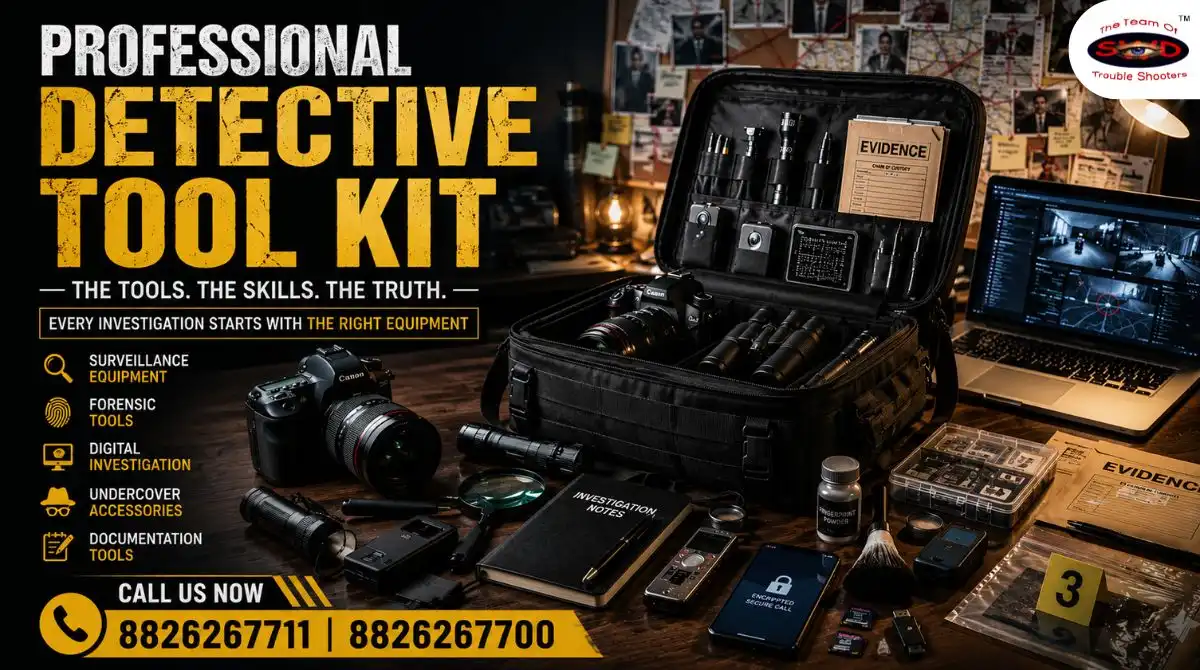
Good investigators don’t just rely on gut feeling — they need the right skills, a solid strategy, and gear they can actually trust. From surveillance work to pre-matrimonial investigations, background checks, corporate fraud cases, insurance verification, cyber probes, or tracking missing persons, every case comes down to gathering facts the right way, legally and accurately.
Mr. Rahul Rai Gupta, founder and CEO of Secret Watch Detectives Pvt. Ltd. and is known as the “Mastermind Detective,” puts it simply — tools mean nothing without experience behind them. Patience, sharp judgment, and proper training are what actually crack a case. This guide walks through the tools that matter and how to build a kit that works.
What Is a Detective Tool Kit?
A detective tool kit is a collection of professional equipment used to gather information, document evidence, conduct surveillance, and support investigations. Depending on the type of case, the kit may include surveillance devices, forensic tools, digital investigation software, documentation supplies, and communication equipment.
Different investigations require different combinations of equipment. For example, surveillance cases may require cameras and GPS devices, while corporate investigations often involve digital forensics tools. Similarly, pre-matrimonial investigations, employee background verification, cyber investigations, and missing person cases each demand specialized investigative techniques and equipment.
Essential Detective Tools Used by Professional Investigators
| Investigation Type | Common Tools |
|---|---|
| Surveillance | Binoculars, Camera, GPS |
| Corporate Investigation | Digital Forensics, Voice Recorder |
| Background Verification | Documentation Tools |
| Missing Person | Drone, GPS, Camera |
A. Surveillance Equipment
Surveillance is one of the most important parts of any investigation. Professional investigators rely on discreet, dependable equipment that helps them observe without drawing attention.
- Binoculars and Night Vision Devices: Useful for observing subjects from a safe distance, especially during outdoor or low-light investigations.
- Hidden Cameras and Body Cameras: Compact cameras help document events and collect visual evidence during surveillance assignments where legally permitted.
- GPS Tracking Devices: GPS trackers can assist in monitoring vehicle movement in investigations where their use complies with applicable laws and proper authorization.
- Audio Recording Equipment: Professional investigators may use specialized recording devices during authorized investigations while ensuring compliance with local privacy laws.
Expert Insight
“Good surveillance isn’t about using the biggest gadget. It’s about using the right tool without attracting attention.” — Mr. Rahul Rai Gupta
B. Forensic Investigation Tools
Collecting and preserving evidence correctly is essential for maintaining its value during an investigation.
- Fingerprint Collection Kit: Includes fingerprint powder, brushes, lifting tape, and collection cards for recovering latent fingerprints.
- UV Flashlight: Helps reveal invisible marks, document alterations, security features, and other evidence that may not be visible under normal lighting.
- Evidence Bags and Labels: Tamper-evident bags and proper labeling help organize evidence and maintain a clear chain of custody.
- Biological Sample Collection Kits: Professionals may use specialized collection kits when authorized and appropriate for the investigation.
C. Digital Investigation Tools
Modern investigations often involve digital evidence alongside traditional fieldwork.
- Digital Forensics Software: Used to recover deleted files, examine digital devices, and analyze electronic evidence where legally authorized.
- Device Detection Equipment: Helps identify unauthorized cameras, microphones, or other electronic surveillance devices during security inspections.
- Encrypted Communication Apps: Secure communication platforms help investigators protect confidential discussions and sensitive case information.
- Camera Drones: When permitted by law, drones can provide aerial views that assist in search operations and large-area surveillance.
D. Undercover Investigation Accessories
Some investigations require investigators to blend naturally into different environments.
- Clothing and Appearance Accessories: Simple changes in clothing, accessories, or appearance can help investigators avoid recognition without drawing unnecessary attention.
- Voice Modification Tools: In limited situations, voice modulation technology may help protect an investigator’s identity during authorized communications.
E. Documentation Tools
Accurate documentation often becomes one of the strongest pieces of evidence in an investigation.
Professional investigators commonly carry:
- A durable notebook
- Waterproof pens
- Digital voice recorder
- Portable power bank
- Flashlight
- Extra memory cards
- Secure digital storage devices
Keeping detailed notes ensures that important observations are not forgotten and can be reviewed later if needed.
How to Build a Practical Detective Tool Kit
Whether you’re planning to become a professional investigator or simply want to understand how investigations are conducted, building a detective tool kit should happen gradually.
1. Start with the Essentials
Begin with practical items such as:
- Flashlight
- Notebook
- Quality camera
- Multi-tool
- Evidence storage supplies
These basic tools are useful in many different types of investigations.
2. Invest in Reliable Surveillance Equipment
- As your skills grow, consider adding equipment such as binoculars, body cameras, or other professional surveillance tools that are appropriate for your work and comply with local laws.
- Focus on reliability, battery life, and ease of use rather than buying the most expensive equipment.
3. Learn Digital Investigation Skills
- Today’s investigations often involve online research and digital evidence.
- Learning digital investigation techniques, cybersecurity basics, and data analysis can be just as valuable as purchasing new equipment.
- According to Mr. Rahul Rai Gupta, investigators who continually update their technical knowledge are better prepared for modern investigative challenges.
4 Organize Your Equipment
- Choose a lightweight backpack or equipment case with separate compartments.
- A well-organized kit allows investigators to access tools quickly while working in the field.
5. Keep Learning
- Even the best equipment cannot replace practical experience.
- Professional investigators improve through continuous learning, observation, and real-world practice. Training in surveillance techniques, interviewing skills, report writing, and legal awareness is just as important as owning quality equipment.
6. Review and Upgrade Your Kit
- Professional investigators regularly evaluate their equipment and replace outdated tools when better, more reliable options become available.
Where Are These Detective Tools Used?
Professional investigators use these tools across a wide range of investigations, including:
- Pre-Matrimonial Investigations
- Post-Matrimonial Investigations
- Corporate Fraud Investigations
- Employee Background Verification
- Insurance Claim Verification
- Cyber Investigations
- Surveillance Assignments
- Missing Person Investigations
- Due Diligence Investigations
- Asset Verification
Essential Points to Remember
- Professional detectives combine experience with specialized investigative tools.
- Surveillance, forensic, digital, and documentation equipment each serve different investigative purposes.
- A detective tool kit should be built based on the type of investigations you conduct.
- Legal compliance and ethical practices are essential when using investigative equipment.
- Continuous training and practical experience remain more valuable than any single tool.
Frequently Asked Questions (FAQs)
What tools do professional detectives use?
Honestly, it depends on the case. Matrimonial cases need more cameras and discreet tracking, but in corporate fraud cases, we spend more time on the laptop with forensic software. If I had to pick just one thing, it’d be the voice recorder — because in 90% of cases, documentation ends up mattering more than any single gadget.
Can beginners build a detective tool kit?
Yeah, absolutely — and you don’t need to go overboard on day one. Most people starting out just need a flashlight, a notebook, a decent camera, and something to keep evidence organized. The fancy equipment can wait; skills come first, gear comes later.
Are surveillance tools legal to use?
This one’s tricky and honestly changes case by case. It’s less about the device itself and more about how and where you use it — a hidden camera in one situation might be totally fine and in another could get you in serious legal trouble. When in doubt, we always tell people to check local laws first, not the equipment specs.
What’s the one tool you can’t do without?
Funny enough, it’s not a gadget at all. Ask any experienced investigator and they’ll probably say the same thing — patience and the ability to read a situation matter more than anything in your bag. Tech helps you see and record things, but it won’t tell you what’s actually important. That judgment comes with time.
Why do professional investigators update their equipment?
Because falling behind on tech can actually cost you a case. A five-year-old camera or an outdated forensic tool might miss something that newer equipment would catch instantly — better resolution, tighter security, less chance of errors. It’s not about chasing every new gadget on the market, it’s about staying sharp enough that your equipment isn’t the weak link in an investigation.
Which investigations require a professional detective tool kit?
Pretty much all of them, just in different combinations. Matrimonial checks, background verifications, corporate fraud, cyber cases, insurance claims, missing persons — the list goes on. Each one pulls from the kit differently, but the common thread is always the same: whatever you collect has to hold up as solid, legally sound evidence later.
Final Thoughts: It’s the Investigator, Not the Equipment
At the end of the day, no amount of gear replaces good instincts. You can have the sharpest tools in the business and still miss the obvious if you don’t know how to read people or situations. As Mr Rahul Rai Gupta puts it — the investigators who actually get results aren’t the ones with the biggest kit, they’re the ones who’ve put in the time to build real judgment. The equipment just helps you act on what you already know how to see.
