
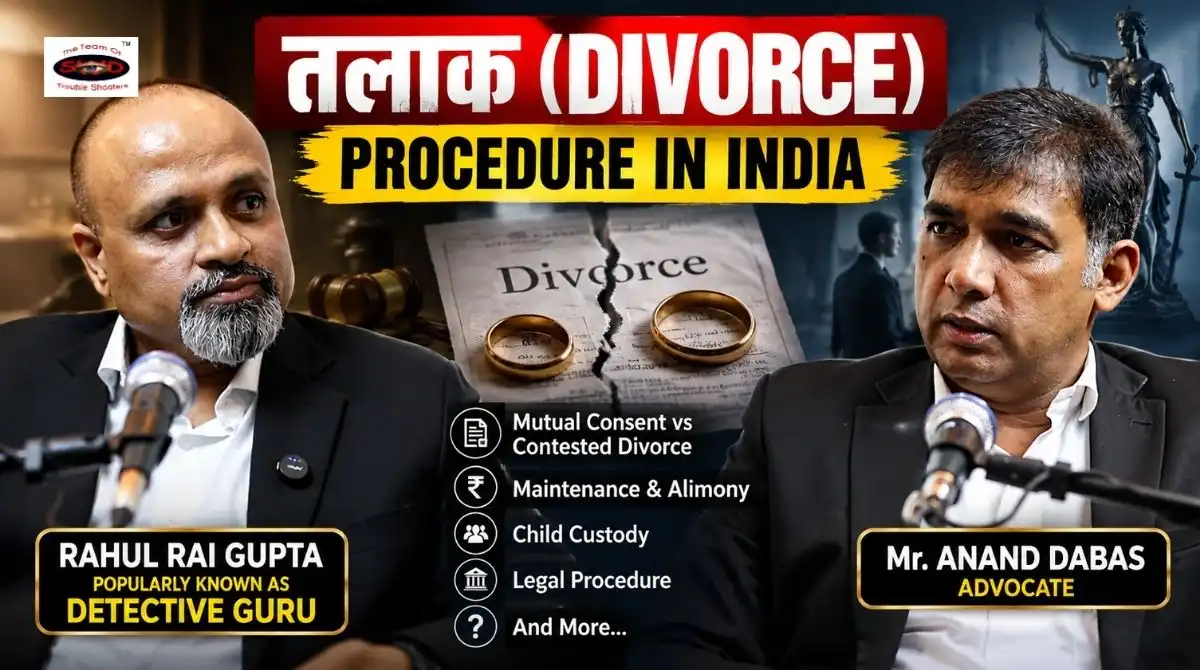
Divorce is a legal process that formally dissolves a marriage through a competent court. For a person considering separation, understanding the divorce procedure in India is important because the process depends on several factors, including whether both spouses agree to the divorce, the applicable personal law, the grounds for divorce, maintenance, children, property and other disputes.
Many people search online for divorce law in India to understand their legal rights and the steps involved. However, the process can vary depending on the law governing the marriage, how the marriage was solemnized, and the specific circumstances of the spouses. Different matrimonial laws may apply to different marriages, so it is important to identify the applicable law before starting legal proceedings.
This article explains the general process in simple language, with particular reference to the Hindu Marriage Act, 1955 and the Special Marriage Act, 1954.
Divorce Law in India: Watch Our Podcast for Practical Insights
Divorce procedure in India समझने के लिए केवल कानूनी provisions पढ़ना ही काफी नहीं होता। अलग-अलग परिस्थितियों में divorce process कैसे आगे बढ़ता है, यह समझना भी जरूरी है।
इसी विषय पर The Investigation Room में एक पूरा podcast episode किया गया है, जिसमें The Mastermind Detective – Mr. Rahul Rai Gupta, popularly known as no 1 detective in india , discussed important Divorce in India questions with Mr. Anand Dabas.
पूरा podcast देखने के लिए यहां क्लिक करें:
इस episode में discuss किए गए practical questions आपको divorce procedure in India और उससे जुड़े legal issues को बेहतर तरीके से समझने में मदद कर सकते हैं।
What Is the Divorce Procedure in India?
The divorce procedure generally involves filing a petition before the appropriate court, notifying the other spouse, presenting the relevant facts and evidence, addressing issues such as maintenance or child custody where applicable, and obtaining a final divorce decree.
There are two commonly discussed forms of divorce:
- Mutual consent divorce, where both spouses agree to end the marriage.
- Contested divorce, where one spouse seeks divorce and the other does not agree or disputes the allegations.
Divorce Procedure in India: Which Law Applies?
There is no single divorce law that applies identically to every marriage in India. For example, the Hindu Marriage Act, 1955 contains provisions relating to divorce for marriages covered by that Act. The Special Marriage Act, 1954 separately provides for divorce for marriages solemnized under that legislation.
Therefore, before starting a divorce case, it is important to determine:
- Under which law the marriage was solemnized
- The religion/personal-law framework applicable to the parties, where relevant
- Where the spouses currently live
- Where the marriage took place
- Whether there are children
- Whether there are existing court cases
- Whether both spouses agree to the divorce
This is one reason why a general internet answer may not be enough to determine the correct procedure for an individual case.
What Is Mutual Consent Divorce?
A mutual consent divorce is used when both spouses agree that the marriage should end and are prepared to approach the court together.
Under Section 13B of the Hindu Marriage Act, the parties must state, among other things, that they have been living separately for at least one year, have not been able to live together, and have mutually agreed that the marriage should be dissolved.
The Special Marriage Act contains a similar provision under Section 28.
How Does Mutual Consent Divorce Work?
The broad process is:
Step 1: Both spouses agree to separate
The spouses decide that they want to legally end their marriage.
Step 2: Financial and family issues are discussed
Depending on the circumstances, the parties may address matters such as:
- Maintenance or alimony
- Child custody
- Child support
- Division or return of belongings
- Pending matrimonial disputes
- Other agreed terms of settlement
Step 3: Joint divorce petition is filed
The spouses jointly approach the appropriate court with the divorce petition.
Step 4: First motion
The court records the statements of the parties and considers whether the statutory requirements have been satisfied.
Step 5: Second motion
Under Section 13B(2) of the Hindu Marriage Act, the second motion is ordinarily made not earlier than six months and not later than eighteen months after presentation of the petition, provided the petition has not been withdrawn.
Step 6: Divorce decree
If the court is satisfied that the statutory requirements have been fulfilled, it can pass a decree dissolving the marriage.
The six-month waiting period under Section 13B(2) is not mandatory in every case. The Supreme Court has held that the court may waive it in appropriate circumstances, depending on the facts of the case.
What Is a Contested Divorce?
A contested divorce happens when the spouses do not have mutual agreement to end the marriage or disagree about the allegations or relief being sought.
Under the Hindu Marriage Act, Section 13 provides several statutory grounds for divorce. These include, among others, adultery, cruelty and desertion for the prescribed period.
In a contested case, one spouse files a petition and the other spouse gets an opportunity to respond.
The broad process may include:
- Filing of the divorce petition
- Court scrutiny and registration
- Notice to the other spouse
- Filing of the response
- Consideration of interim applications
- Evidence from the parties
- Cross-examination where required
- Final arguments
- Judgment and divorce decree
The actual sequence can vary depending on the court and circumstances.
How Long After Marriage Can Divorce Be Filed?
Under the Hindu Marriage Act, a divorce petition ordinarily cannot be presented until one year has elapsed from the date of marriage. However, the court may allow an earlier petition in cases involving exceptional hardship to the petitioner or exceptional depravity on the part of the respondent, subject to the statutory requirements.
A similar one-year restriction appears in Section 29 of the Special Marriage Act, with an exception for exceptional hardship or exceptional depravity.
This means that the commonly stated “one-year rule” has an important statutory exception.
What Are the Grounds for Divorce in India?
The grounds depend on the law applicable to the marriage.
Under Section 13 of the Hindu Marriage Act, grounds include:
- Adultery
- Cruelty
- Desertion for the prescribed period
- Conversion from Hinduism
- Certain forms of mental disorder as specified by the Act
- Certain communicable venereal diseases
- Renunciation of the world
- Presumption of death where the spouse has not been heard of for seven years
A person should therefore avoid assuming that every marital disagreement automatically becomes a legal ground for divorce.
What Is the Difference Between Mutual and Contested Divorce?
The biggest difference is consent.
| Point | Mutual Consent Divorce | Contested Divorce |
|---|---|---|
| Consent | Both spouses agree to end the marriage. | One spouse seeks divorce, while the other may oppose or dispute it. |
| How it starts | Both spouses jointly approach the court. | One spouse files a divorce petition against the other. |
| Main requirement | Mutual agreement to dissolve the marriage, subject to applicable legal requirements. | The spouse seeking divorce must establish a legally recognized ground. |
| Disputes | Financial, custody and other issues may be settled by agreement. | Issues may be disputed and decided through court proceedings. |
| Evidence | Usually less litigation over disputed allegations. | Evidence and cross-examination may be required depending on the case. |
| Duration | The process follows the statutory motion requirements and court procedure. | Duration can vary significantly depending on evidence, hearings, court workload, interim applications and appeals. |
| Outcome | The court may grant a divorce decree after being satisfied that the legal requirements are fulfilled. | The court decides the case after considering the pleadings, evidence and applicable law. |
Can You Claim Maintenance During Divorce Proceedings?
Maintenance and financial support can become important issues in matrimonial proceedings.
The applicable law and the facts of the case determine whether a person can claim maintenance or litigation expenses and which factors the court considers.
The fact that a spouse is employed does not automatically answer the question of maintenance. Income, financial circumstances, reasonable needs and the applicable statutory provision can all matter.
Similarly, maintenance and a one-time settlement are not necessarily the same thing. A settlement may involve a lump-sum amount covering agreed claims, while maintenance can involve periodic payments depending on the applicable order.
Because financial relief depends on the specific facts of each case, the court considers it separately from the question of whether it can grant a divorce.
What Happens to Children During Divorce?
If the couple has children, divorce proceedings may also involve:
- Child custody
- Visitation or parenting arrangements
- Child support
- Education and medical expenses
- Other welfare-related issues
The court’s consideration of children is separate from the simple question of whether the marriage should be dissolved.
Parents should keep the child’s welfare and practical arrangements in mind while discussing a settlement.
What is an Ex-Parte Divorce?
An ex-parte proceeding can arise when one party does not appear despite proper service of court notice and the court proceeds without that party.
The important points are:
- An ex-parte decree does not mean that a spouse can obtain a divorce without following court procedure.
- Proper service of court notice and other procedural requirements remain important.
- A person against whom an ex-parte decree has been passed may have legal remedies in appropriate circumstances.
- The exact remedy, limitation period and requirements depend on the facts and applicable procedural law.
- Anyone who discovers an ex-parte divorce decree should obtain the relevant court record promptly.
- Legal advice should be taken before assuming that the decree cannot be challenged.
Can Concealment Before Marriage Affect a Divorce Case?
Concealment of significant information before marriage can raise legal issues in certain circumstances.
For example, if a person alleges that someone deliberately concealed important information or obtained consent to the marriage through fraud, the court considers the applicable law and available evidence.
The difficult part is often proving:
- What information existed before marriage
- Who knew about it
- Whether it was deliberately concealed
- Whether it was material to consent
- When the other spouse discovered it
- Whether the statutory time limits and other requirements are satisfied
Therefore, discovering an unpleasant fact after marriage does not automatically qualify you for an annulment or divorce.
Can Social Media Posts Create Legal Problems During Divorce?
Divorce disputes sometimes extend beyond the courtroom and onto social media.
Posts containing allegations about a spouse can potentially create separate legal issues depending on their content, publication, audience and the applicable law.
If a person believes that a statement has damaged their reputation, the appropriate legal remedy depends on the facts. Screenshots, URLs, dates and other relevant records may become important evidence.
People involved in divorce proceedings should therefore be careful about posting allegations publicly, particularly while a dispute is already before a court.
Where Can You File a Divorce Case in India?
The appropriate court depends on the applicable matrimonial law and jurisdictional rules.
Factors may include:
- Place of marriage
- Place where the spouses last lived together
- Current residence of the parties
- Applicable matrimonial legislation
- Specific jurisdictional provisions
Family Courts are established under the Family Courts Act, 1984 to deal with disputes relating to marriage and family affairs, with an emphasis on conciliation and settlement of such disputes.
A lawyer can determine the appropriate court after examining the specific facts.
Documents Commonly Required for Divorce
The exact documents depend on the case, but a divorce matter may require documents such as:
- Marriage certificate or other proof of marriage
- Identity and address documents
- Photographs, where required
- Details of children
- Evidence relating to income
- Previous court orders
- Relevant correspondence or communications
- Evidence supporting the grounds of divorce
- Settlement documents in a mutual consent matter
Not every document will be required in every case.
How to Prepare Before Filing for Divorce
Before filing, it is useful to organize the facts chronologically.
Keep records of:
- Date and place of marriage
- Periods of separation
- Important incidents
- Previous complaints or court cases
- Financial information
- Children’s details
- Relevant communications
- Existing settlement discussions
- Any previous divorce proceedings
Do not manufacture, alter or selectively manipulate evidence. The usefulness of evidence depends on its authenticity, relevance and admissibility under the applicable law.
How Should You Choose a Divorce Lawyer?
Choosing a lawyer should involve more than looking at online advertisements.
Consider checking:
- Experience in matrimonial and family-law matters
- Experience before the relevant court
- Communication and availability
- Clarity about fees and expenses
- Understanding of your particular facts
- Whether the lawyer explains realistic legal options
- Whether you receive copies of important filings and orders
A lawyer should not promise a guaranteed outcome or a guaranteed timeline. Court proceedings depend on the facts, evidence and judicial process.
Divorce Procedure in India: A Simple Step-by-Step Summary
For a general understanding, the process can be remembered as:
1. Understand your legal position
Identify the applicable matrimonial law and your circumstances.
2. Decide whether the matter is mutual or contested
This determines the broad route of the case.
3. Collect relevant documents and evidence
Keep records organized and authentic.
4. Identify the appropriate court
Jurisdiction must be established before filing.
5. File the petition
The petition sets out the relevant facts and legal grounds.
6. Court proceedings begin
Depending on the case, this may involve notice, response, mediation, evidence and hearings.
7. Resolve financial and child-related issues
Maintenance, alimony, custody and other disputes may need separate consideration.
8. Obtain the final decree
The marriage is legally dissolved when the competent court grants the divorce decree.
9. Check appeal-related requirements before remarriage
The legal finality of the decree should be verified.
Frequently Asked Questions (FAQs) About Divorce Procedure in India
What Can a Wife Claim in Divorce?
Depending on the applicable law and facts of the case, a wife may claim maintenance, litigation expenses, permanent alimony, child-related relief, and other financial or legal reliefs available under the applicable law. Under the Hindu Marriage Act, both the wife and husband can apply for maintenance during proceedings and permanent alimony, subject to the court’s assessment of the circumstances.
Who Loses Most in a Divorce?
There is no fixed rule about who loses more in a divorce. The financial and personal impact can depend on income, property, maintenance obligations, child-related responsibilities, legal expenses and the circumstances of the marriage.
How Long Is the Divorce Process in India?
The time required depends on whether the divorce is by mutual consent or contested. Mutual consent cases generally involve statutory requirements and court proceedings, while contested cases can take longer because they may involve evidence, hearings, interim applications, and appeals. The exact duration varies from case to case.
What Are the 7 Stages of Divorce?
The seven emotional stages of divorce are often described as denial, fear, anger, bargaining, guilt, depression and acceptance. However, not everyone experiences these emotions in the same order or experiences all of them.
What Is the Biggest Mistake During a Divorce?
One of the biggest mistakes during a divorce is making important decisions based only on emotions. Avoid hiding relevant information, destroying evidence, making threats, or posting allegations about your spouse on social media. Keep important documents and communications safely and discuss major legal decisions with your lawyer.
Who Regrets Most After Divorce?
There is no fixed answer to who regrets divorce more. Emotional reactions vary from person to person and may depend on the circumstances of the marriage, the reason for separation, financial situation, children, and the way the divorce takes place.
What Is the Hardest Stage of Divorce?
The hardest stage of divorce can vary from person to person. Some people find the initial separation and uncertainty difficult, while others struggle more with court proceedings, financial issues, child-related matters, or adjusting to life after the marriage ends.
What Should a Wife Not Do During Separation?
During separation, a wife should avoid making threats, deliberately destroying or hiding relevant evidence, violating court orders, or making unverified allegations publicly. She should also avoid taking major legal or financial decisions without understanding their possible consequences. The appropriate steps depend on the facts of the case and the applicable law.
How long does divorce take in India?
There is no single fixed duration for every divorce case. Mutual consent proceedings and contested proceedings follow different processes, and the actual duration depends on the applicable law, court and circumstances.
Can I get a divorce without my spouse’s consent?
A spouse’s consent is not required for a contested divorce. However, the person seeking divorce must establish a legally recognized ground and satisfy the applicable requirements.
Is mutual consent divorce always completed in 6 months?
No. The six-month period under the Hindu Marriage Act relates to the statutory second-motion framework, but the Supreme Court has recognized that the waiting period can be waived in appropriate cases.
भारत में तलाक का कानून क्या है?
तलाक का कानून विवाह पर लागू व्यक्तिगत कानून और मामले की परिस्थितियों पर निर्भर करता है। तलाक आपसी सहमति (Mutual Consent) या विवादित तलाक (Contested Divorce) के जरिए लिया जा सकता है। भरण-पोषण, बच्चों की कस्टडी, संपत्ति और अन्य कानूनी अधिकार भी लागू कानून और मामले की परिस्थितियों के आधार पर तय होते हैं।
भारत में पुरुषों के लिए तलाक के कानून कितने निष्पक्ष हैं?
भारत में तलाक के कानून पति और पत्नी दोनों को कानूनी अधिकार और उपाय प्रदान करते हैं। हालांकि, किसी मामले में लागू अधिकार और जिम्मेदारियां संबंधित व्यक्तिगत कानून और मामले के तथ्यों पर निर्भर करती हैं। तलाक के आधार, भरण-पोषण, बच्चों की कस्टडी और संपत्ति जैसे मामलों का निर्णय लागू कानून और परिस्थितियों के अनुसार किया जाता है।
